- Screen Colours:
- Normal
- Black & Yellow
The Government has published its decision in regard to the LGR in March 2026. It has chosen to create three new unitary councils. All existing councils in Suffolk will be replaced in 2028 by new unitary councils covering these geographical areas:
-
West Suffolk
-
East Suffolk
-
South Suffolk and Ipswich
-
What happens next?
The exact boundaries for the three new councils are still being finalised, but from May 2028 they will replace the existing councils as follows:
-
West Suffolk will take over from West Suffolk Council and parts of Babergh and Mid Suffolk.
-
East Suffolk will replace East Suffolk Council and parts of Mid Suffolk.
-
South Suffolk and Ipswich will replace Ipswich Borough Council and parts of Babergh and East Suffolk.
Each new council will also need to take on all the services currently delivered by Suffolk County Council in its area. This means adult social care, children’s services, highways, planning, waste collection and more will all need to be carefully separated and rebuilt three times over - a huge and complex piece of work.
Elections for the new shadow councils will be held in May 2027, with the new authorities formally taking control in May 2028.
During the transition, all services will continue as normal
Update June 2026
Below is a timeline of the required stages f.y.i.
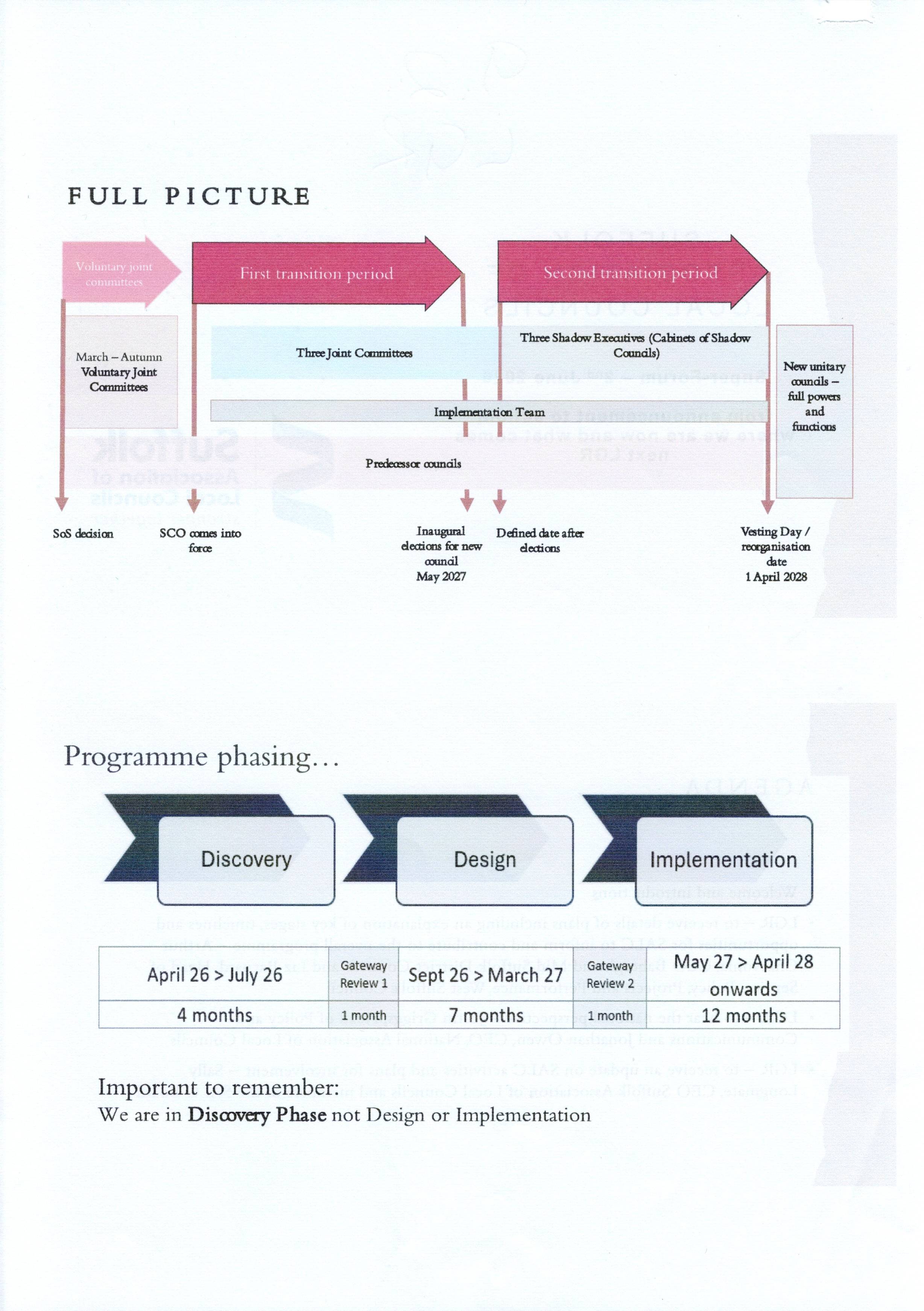
Update May 2026:
Sent on behalf of the Suffolk LGR Implementation Board
As the Implementation Board charged with delivering Local Government Reorganisation in Suffolk, we want to share with you the first details of a new website - jointly created by Suffolk’s county, district and borough councils - providing simple and clear information and updates about Local Government Reorganisation in Suffolk.
It is part of our commitment to ensuring residents and communities are aware of LGR, why it is happening, and what it means for them as we transition to three new unitary councils.
The Future Suffolk website www.suffolklgrhub.gov.uk, developed in-house by our communications teams, will evolve as plans progress. But it already includes:
- explainers about LGR
- a timeline of the LGR process and key milestones
- maps showing the new council boundaries
- details about the 2027 shadow authority elections.
The site also includes an interactive map showing provisional ward names and boundaries, as well as details of the number of councillors. These boundaries have been shaped in accordance with the Boundary Commission for England's guidance and by working with cross-party groups of councillors over the past few months, with the support of our democratic service and elections teams. You can preview the site here: https://preview-suffolklgr-scc.cloud.contensis.com/
The website brings everything together in one place and ensures these complex changes are communicated in a clear, consistent and transparent way. It also provides a single point of contact for residents, and the opportunity to submit questions and comments. Please note Future Suffolk is a temporary website and identity being used to communicate these changes – it is not a brand for the new councils.
We will continue to keep you fully informed in the weeks and months ahead, and there will be regular opportunities to ask questions.
If you have any questions about any of the above, please feel free to contact any of us.
Thank you,
Mark Ash – Joint Chief Executive, Suffolk County Council and Suffolk LGR Senior Responsible Officer
Chris Bally – Chief Executive, East Suffolk Council
Arthur Charvonia - Chief Executive, Babergh & Mid Suffolk District Councils
Andrew Cook – Joint Chief Executive, Suffolk County CouncilGareth Everton – Executive Director of Adult Social Care, Suffolk County Council
Ian Gallin – Chief Executive, West Suffolk Council
Helen Pluck – Chief Executive, Ipswich Borough CouncilSarah Jane Smedmor - Executive Director of Children and Young People’s Services, Suffolk County Council
The Devolution process is about creating a mayoral combined county authority (MCCA) covering Norfolk and Suffolk with one Mayor presiding over both counties. Candidates are already putting their names forward for this unique position. Elections will now take place in May 2028, a delay of 2 years. The successful candidate will be in post for 4 years, in other words, elections every 4 years. The Government are mandating it so it will be nationwide whether counties want it or not. The process will give new powers and funding to boost jobs, transport, housing and growth to Norfolk and Suffolk.
The normal County and District Borough elections will still be held in May 2026, and County and District Councillors elected. However they will only be in post for 2 years, not the usual 4 year-term because of the Devolution timetable, thus meaning the the new LGR won't come into effect until 2028. Shadow elections to the new unitary councils, and we do not yet know how many of these there will be, will take place in May 2027 but will actually only 'kick in' in May 2028. As a result of this, it means Parish Councils will not have to pay the election costs as was first muted.
According to the government, Devolution means:
- The transfer of powers and funding from Whitehall, to enable decisions on jobs, skills, transport and housing to be taken in Norfolk and Suffolk. The Greater Manchester Authority under Andy Burnham is an example of a succesful Mayoral authority.
- A £1.1 billion investment fund for 30 years, to spend on local priorities
Documents to date:
A Residents Guide to Devolution
Suffolk LGR Interim Plan issued by the 5 District & Borough Councils in Suffolk