- Screen Colours:
- Normal
- Black & Yellow
Suffolk Connected is working with Neighbourhood Watch to issue advice. Up to date information will be posted here as it is received.This will be in a pdf format to save overloading this page so please click on the relvant newsletter for the latest information and advice.
Thefts from vehicles - security advice from your CPT
Having your car broken into and losing your things to thieves can be very distressing. Here are a few simple steps you can take to keep your vehicle, and what’s in it, safe.
Most car thieves are opportunists. By taking a few simple steps, you can drastically reduce the chance of becoming a victim. Help us keep our community safe!
Here are three golden rules from the Community Policing Team (CPT) to follow every time you leave your vehicle:
• Lock it : Always double-check your doors and windows are secure, even if you're just "running in for a second". A surprising number of thefts happen through unlocked doors.
• Light it : Park in well-lit areas or near streetlamps whenever possible. Most vehicle crime happens at night, and good lighting is a great deterrent as well as good CCTV .
• Empty it : Never leave valuables, bags, or even loose change on display. If a thief sees something worth taking, they might break in to get it. Take your belongings with you or hide them completely out of sight.
Bonus Tip for Keyless Cars:
If you have a keyless entry fob, store it in a signal-blocking pouch (a "Faraday bag") when you're at home to prevent "relay theft".
Share these tips with friends and family to spread the word!
Preventing theft from a vehicle >> Prevent theft from a vehicle | Crime Prevention | Suffolk Constabulary
Beware of winter fuel payment scams
Between April and September 2025, Action Fraud has received 2,790 crime reports relating to Winter Fuel Payment scams, with victims reporting losses totalling over £27,000.
Winter Fuel Payments are made automatically, you do not need to do anything. If you receive any text messages about Winter Fuel Payments, it’s a scam.
Not sure if a message is real? Contact the organisation directly using the contact details on their official website, not the number or web address in the message. Your bank (or any other official source) won’t ask you to supply personal information by email or text message.
If you have spotted a suspicious SMS or RCS message, you can report it for FREE by forwarding it to 7726.
If you think you’ve been a victim of fraud, contact your bank immediately and report it to Action Fraud online at actionfraud.police.uk or by calling 0300 123 2040, or call Police Scotland on 101
ALERT: WhatsApp account takeover scam
Criminals are targeting WhatsApp users by posing as a friend and asking for a security code. Action Fraud has received over 60 reports relating to this scam.
The scam begins when a criminal gets access to another WhatsApp account which has you listed as a contact.
The criminal, posing as your friend or someone that’s a member of a WhatsApp group you’re in, will then send you seemingly normal messages to try and start a conversation with you. However, around the same time you will receive a text message from WhatsApp with a six-digit code. This is because the criminal has been trying to login to WhatsApp using your mobile number. The criminal will claim that they sent you their code by accident and ask you to help them by sending it to them. Once the criminal has this code, they can login to your WhatsApp account and lock you out.
The criminal will then use the same tactic with your WhatsApp contacts in an effort to steal more accounts and use them to perpetrate fraud.
What you need to do: · Set up two-step verification to give an extra layer of protection to your account: Tap Settings > Account >Two-step verification > Enable.
· THINK. CALL. If a family member or friend makes an unusual request on WhatsApp, always call the person to confirm their identity.
· Never share your account’s activation code (that’s the 6 digit code you receive via SMS)
· You can report spam messages or block a sender within WhatsApp. Press and hold on the message bubble, select ‘Report’ and then follow the instructions.
If you have been a victim of fraud or cyber crime, report it to Action Fraud or 0300 123 2040.
(If you found the information in this alert useful, please share it with your friends and family. Social media versions of this alert can be found on Twitter, Facebook and Instagram)
Fraud! Spot it and Stop It!
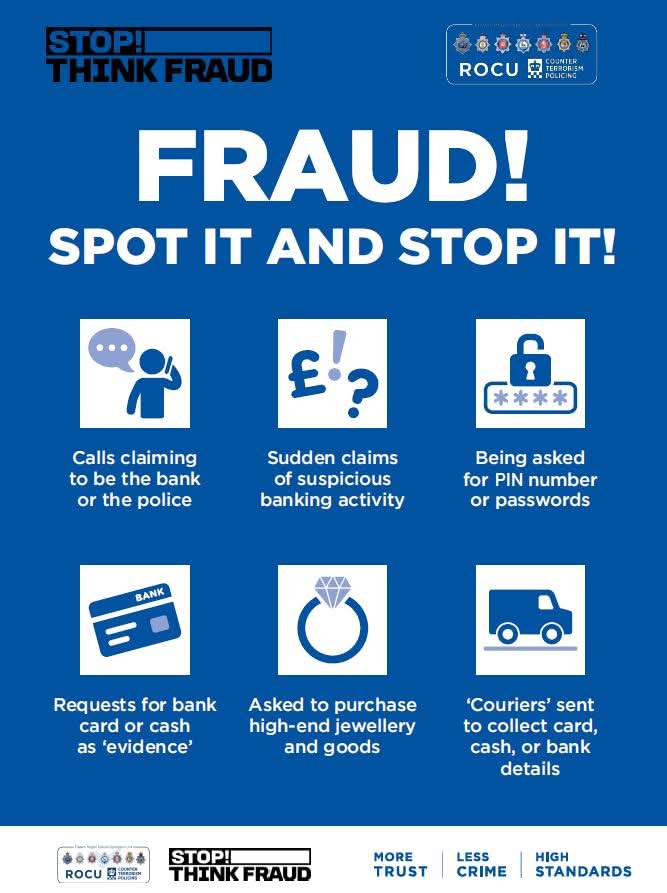
Do you know the signs of Courier Fraud? Updated Feb 2026:
Suffolk police warn of courier fraud targeting elderly following recent reports
Police are urging families, friends and neighbours to make their elderly relatives or vulnerable members of the community aware of courier fraud after two incidents were reported to police this week. Courier fraud occurs when people are contacted by people pretending to be police officers or bank officials and duped into handing over money, valuables or bank cards, which are collected from their home address, often by couriers. The criminals use a variety of different tactics, often claiming that there is a problem with your account and they need your help to catch the real criminals.
The first incident occurred in the mid Suffolk area, the second incident in west Suffolk. Both involved a female victim aged in her 80s who are reported to have lost a significant sum of money. Police are urging residents to share this warning with elderly and vulnerable family members, friends and neighbours – but stress that anyone can fall victim to these sophisticated scams. If you know of anyone that you feel might be susceptible to this, please help ensure they are aware of the dangers and consider measures such as call blockers.
DC John Payne of Suffolk Constabulary’s Fraud Assessment Unit said: “Courier fraud is a cruel and calculated crime. Criminals who carry out courier fraud will exploit a number of tactics, preying on the vulnerable, the elderly, and those that trust services such as police and banks the most. However, this can happen to anyone. These criminals are highly convincing and will go to great lengths to make their story sound legitimate. Both reports this week have described being contacted by someone claiming to be from the police and it’s important that people know police would never call you to ask you to withdraw money to be collected by an officer. Nor would they ask you to transfer money into a different bank account.
Please share this important advice with your friends, your family and your neighbours and make sure they know what to do if contacted.
If you have any concerns about the legitimacy of the call please contact Suffolk police, ideally via another phone line or other method, to verify the details of the officer provided in the call.
Courier fraud- Courier fraud occurs when people are contacted by people pretending to be police officers or bank officials and duped into handing over money, valuables or bank cards, which are collected from their home address, often by couriers. The criminals use a variety of different tactics, often claiming that there is a problem with your account and they need your help to catch the real criminals. The victim may also be encouraged into handing over their bank cards, bank details and PINs, as well as handing over or buying high value items such as jewellery, watches and gold. Older people are sadly the most likely to be targeted by criminals carrying out courier fraud.
Examples of courier fraud include:
A scammer calling you, claiming to be from your bank or a police officer. They tell you either that:
A fraudulent payment has been spotted on your card that needs sorting out
Someone has been arrested using your details and cards
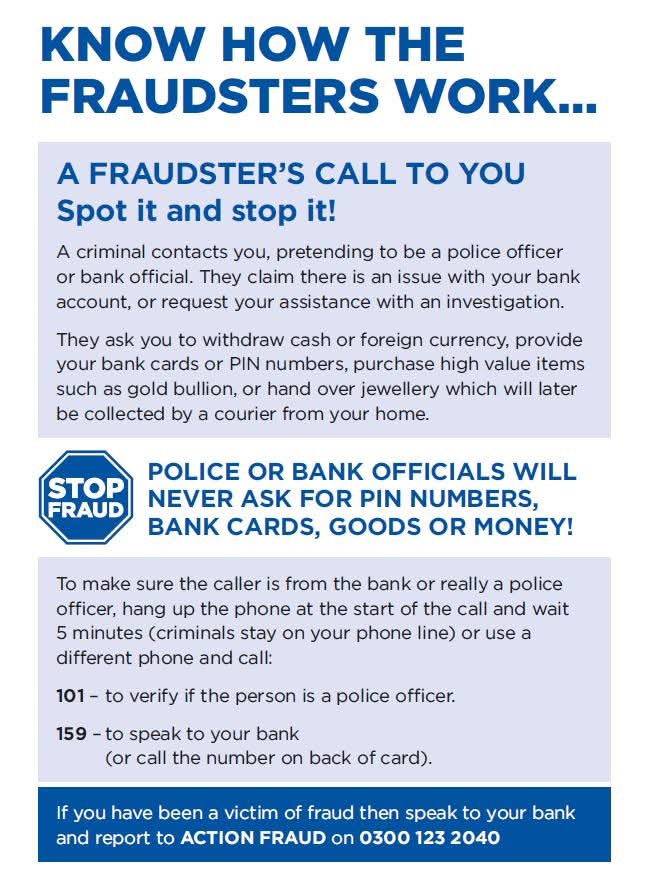
You may be asked to call your bank using the phone number on the back of your card. This convinces you that the call is genuine. But the scammer has kept the line open at their end, so when you make the call, you're unknowingly connected straight back to them or their friends. They’ll either ask you for your PIN or ask you to key it into your phone. No bank or other legitimate service will ever ask you for your PIN. The scammer then sends a courier or taxi to pick up the card from your home. Even the driver may not know they’re being used as part of the scam. Once the scammer has both your card and PIN they can spend your money.
A different version of this scam is where you’re contacted and told there’s a corrupt member of staff at your bank, post office or bureau de change and the police need your help to identify them. They ask you to withdraw a large sum of your money, which the police or bank will mark, then put back into the banking system. They say this will help them identify the corrupt person. Once you hand the cash over, the scammers simply take it. Victims are sometimes asked to meet the ‘couriers’ in public places such as supermarkets or retail parks.
Another example is when a fake police officer phones or approaches you and asks you to buy an expensive watch or other high-value item, to try to find out if counterfeit goods are being sold. Once you’ve bought the item, the scammer tells you to hand it to a taxi driver for transfer to the police. The expensive item is, of course, taken instead to the scammer’s partner.
The latest variation is where the scammer contacts you and says your bank account has been taken over and you need to transfer all the funds into a ‘safe account’. Of course, the new account is operated by the scammers, who then steal the funds. Victims are not just elderly or vulnerable people. Those responsible are professionals, they know what to say and are very convincing.
For more details about checking police officers’ identities, please visit: How to check an officer's identity | Suffolk Constabulary
Police officers will never:
Ask for bank details or PINs
Request cash or bank card handovers to couriers
Demand money transfers to other accounts
Ask for payment of fines or fees over the phone
Request access to your computer or passwords
Ask you to 'assist' in an investigation by doing any of the above
If you have any concerns or feel you or someone you know may have been targeted, please report it.
Reports can be made to both the police and to Action Fraud, while further advice on this and other scams is available on the Report Fraud website - Courier fraud - Report Fraud
For more information read the handy guides or visit Door-to-door and courier fraud | Suffolk Constabulary
More information can also be found about other types of fraud on Action Fraud, you can also report information to Action Fraud on 0300 123 2024 or visit their website >> Action Fraud
ROMANCE FRAUD:
New figures from City of London Police, the National Lead Force for fraud, show that more than £106 million was lost to romance fraud in the UK last year, with more £407,923 lost in Suffolk across 114 incidents. Data from the National Fraud Intelligence Bureau (NFIB) reveals a national 9% increase in romance fraud reports in the past year financial year, with a 1.2% increase in Suffolk. On average, victims nationally lost £11,222.
Detective Superintendent Oliver Little, from the City of London Police, said: "Romance fraud isn’t just a financial crime—it’s a deeply personal betrayal that can leave lasting emotional scars. For the second consecutive year, male victims have slightly outnumbered females, challenging outdated stereotypes about who is affected by these scams.
“Despite this, stigma still surrounds romance fraud victims, often driven by misconceptions that they are foolish or lack judgment. In reality, criminals use sophisticated tactics to manipulate emotions and gain trust, making anyone vulnerable.
“We want to remind everyone that romance fraud can happen to anyone, regardless of gender or background. If something doesn’t feel right in an online relationship, take a step back, verify identities, and seek advice. Speaking up can not only protect yourself, but also help prevent others from falling victim and bring those responsible to justice."
Breaking outdated stereotypes, national data reveals that—for the second consecutive year—male victims slightly outnumber female victims, challenging the misconception that romance fraud primarily targets elderly women. However, while more men reported cases, female victims tended to lose larger sums of money.
The 50-59 age group experienced the highest financial losses, totalling £22,108,334. This demographic is particularly vulnerable as they often have greater financial resources, are still in the workforce, and may be experiencing personal life changes such as divorce, separation, or the loss of a partner, making them prime targets for fraudsters.
One key tactic used by scammers is ‘love bombing’, where fraudsters overwhelm victims with excessive affection, manipulation, and emotional control to create dependency. Intelligence gathered by City of London Police suggests that nearly twice as many female victims engaged with suspects for a year or more compared to males.
Romance fraud isn’t just about losing money — it’s about emotional betrayal, psychological harm, and the erosion of trust. City of London Police urges the public to question suspicious relationships, verify identities, and protect both their hearts and their bank accounts.
How to stay safe from romance fraudsters:
- If you have met someone via a dating app, stay within the messaging function of the application. Don’t feel pressured to hand over your mobile number and move the conversation over to SMS or a messaging platform like WhatsApp or Telegram.
- Be suspicious of any requests for money from someone you have never met in person.
- Be cautious about how much personal information you are sharing online and who you are sharing information with.
- Speak to your family or friends to get advice and perspective. Fraudsters will subtly isolate you for their own purposes.
- Profile photos may not be genuine. Performing a reverse image search can find photos that have been taken from somewhere, or someone, else.
It is important that no matter how long you’ve been speaking to someone online and how much you think you trust them, if you have not met them in person, it’s important that you do not:
- send them any money, even in the form of gift cards;
- allow them access to your bank account;
- transfer money on their behalf;
- take a loan out for them;
- provide copies of your personal documents, such as passports or driving licenses;
- invest your own money on their behalf or on their advice;
- purchase and send the codes on gift cards; or
- agree to receive and/or send parcels on their behalf (laptops, mobile phones etc.)